
GED Prep Program — Full 144‑Lesson Curriculum

Wishlist Share

About Course

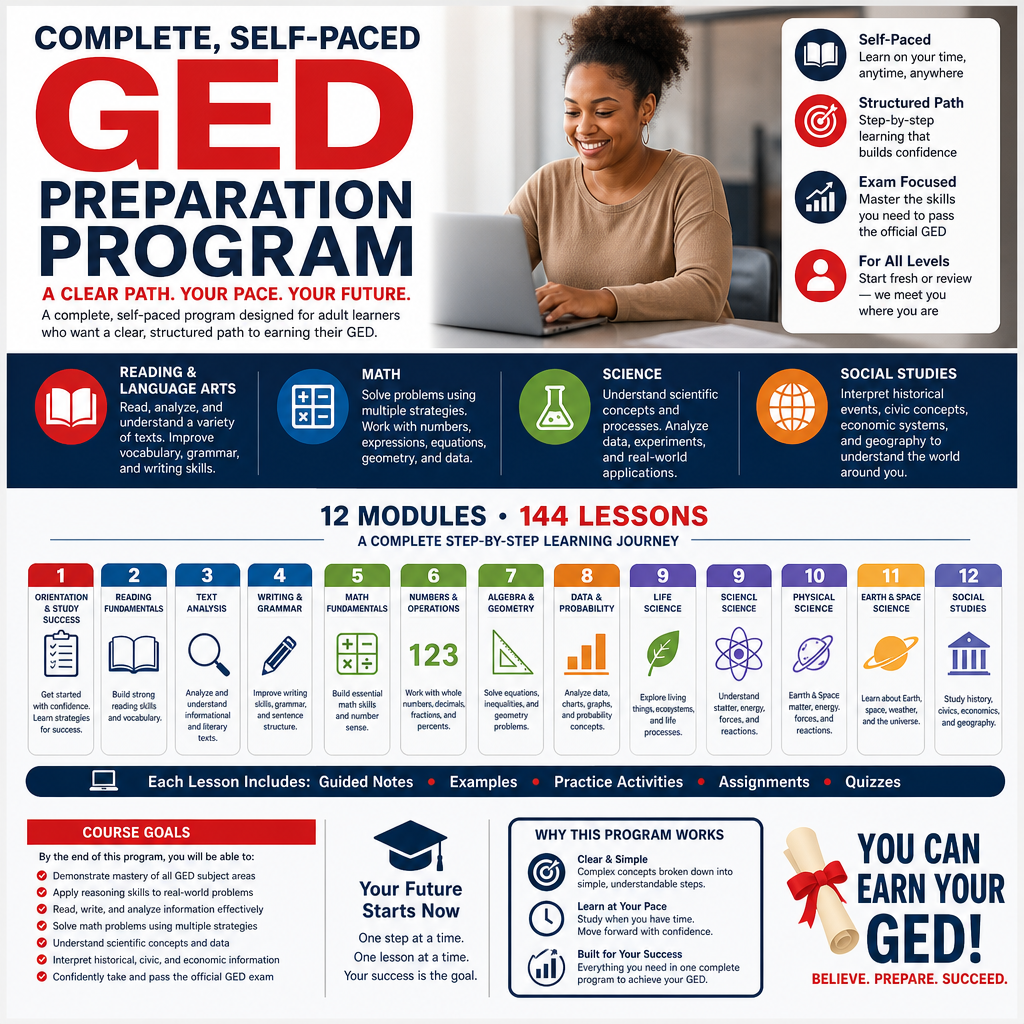
A complete, self‑paced GED preparation program designed for adult learners who want a clear, structured path to earning their GED. This course includes 12 modules and 144 lessons covering all four GED subject areas: Reading & Language Arts, Math, Science, and Social Studies. Each lesson includes guided notes, examples, practice activities, assignments, and quizzes to reinforce learning and build confidence.

This program is built for students at all skill levels — whether you’re starting fresh or reviewing before the exam. Every module breaks down complex concepts into simple, understandable steps, ensuring you learn at your own pace with no stress or confusion.

Course Goals

By the end of this program, students will be able to:

  • Demonstrate mastery of all GED subject areas

  • Apply reasoning skills to real‑world problems

  • Read, write, and analyze information effectively

  • Solve math problems using multiple strategies

  • Understand scientific concepts and data

  • Interpret historical, civic, and economic information

  • Confidently take and pass the official GED exam

Show More

What Will You Learn?

  • 📘 RLA (Reading & Language Arts)
  • Build strong reading comprehension, grammar, writing, and essay skills. Learn how to analyze arguments, understand text structure, and write clear, organized responses.
  • 📘 Math
  • Master numeracy, algebra, equations, geometry, graphs, and GED‑level math reasoning. Lessons progress from foundational skills to advanced problem‑solving.
  • 📘 Science
  • Explore life science, physical science, Earth and space systems, and the scientific method. Learn how to interpret data, understand experiments, and apply scientific reasoning.
  • 📘 Social Studies
  • Study U.S. history, civics and government, economics, and geography. Build skills in analyzing sources, interpreting graphs, and understanding historical and civic processes.

Course Content

📘 MODULE 1 — RLA: Reading Comprehension (Lessons 1–12)
This module builds foundational reading skills needed for the GED exam. Students learn how to identify main ideas, analyze supporting details, understand author’s purpose, make inferences, and interpret tone and mood. They also practice reading charts, graphs, and paired passages — essential for GED‑level reasoning. By the end of this module, students will be able to confidently break down any reading passage and extract key information.

📘 MODULE 2 — RLA: Grammar & Writing Skills (Lessons 13–24)
This module strengthens core grammar and writing mechanics. Students learn parts of speech, sentence structure, punctuation rules, capitalization, transitions, and paragraph organization. These lessons help students write clearly, avoid common grammar mistakes, and prepare for the writing portions of the GED exam. By the end, students will produce cleaner, more accurate writing.

📘 MODULE 3 — RLA: Essay & Argument Analysis (Lessons 25–36)
This module prepares students for the GED Extended Response. Students learn how arguments work, how to evaluate evidence, how to write thesis statements, and how to structure essays. They practice writing introductions, body paragraphs, and conclusions. The module ends with guided and independent essay practice, ensuring students can write a complete, well‑reasoned GED essay.

📘 MODULE 4 — Math: Numeracy Foundations (Lessons 37–48)
This module builds essential math basics. Students review place value, addition, subtraction, multiplication, division, fractions, decimals, ratios, and proportions. These lessons create a strong foundation for more advanced math topics. By the end, students will be comfortable with everyday math operations and ready for algebra.

📘 MODULE 5 — Math: Algebra & Equations (Lessons 49–60)
This module introduces algebraic thinking. Students learn variables, expressions, combining like terms, distributive property, one‑step and multi‑step equations, inequalities, graphing, and solving linear equations. They also explore basic systems of equations. By the end, students will understand how algebra works and how to solve real‑world problems using equations.

📘 MODULE 6 — Math: Geometry, Graphs & GED Reasoning (Lessons 61–72)
This module covers geometry and data interpretation. Students learn perimeter, area, volume, surface area, circle measurements, graphing functions, probability, and statistics. They also practice GED‑level word problems and reasoning skills. By the end, students will be able to interpret graphs, solve geometry problems, and analyze data confidently.

📘 MODULE 7 — Science: Life Science (Lessons 73–84)
This module explores living organisms and biological processes. Students learn cell structure, photosynthesis, respiration, genetics, evolution, ecosystems, food webs, and human body systems. By the end, students will understand how living things function and interact with their environment — key concepts for the GED Science test.

📘 MODULE 8 — Science: Physical Science (Lessons 85–96)
This module covers chemistry and physics basics. Students learn states of matter, atoms, molecules, chemical reactions, physical vs chemical changes, motion, forces, Newton’s laws, energy, electricity, and waves. By the end, students will understand how matter and energy behave in the physical world.

📘 MODULE 9 — Science: Earth & Space + Scientific Method (Lessons 97–108)
This module focuses on Earth systems and scientific investigation. Students learn Earth’s layers, plate tectonics, erosion, weather, climate, atmosphere, solar system, gravity, and orbits. They also study the scientific method, variables, and data analysis. By the end, students will be able to interpret scientific data and understand Earth and space science concepts.

📘 MODULE 10 — Social Studies: U.S. History (Lessons 109–120)
This module covers major events in U.S. history. Students learn about Native American cultures, colonization, the 13 colonies, the American Revolution, the Constitution, the Bill of Rights, westward expansion, the Civil War, Reconstruction, and industrialization. By the end, students will understand how the United States developed socially, politically, and economically.

📘 MODULE 11 — Social Studies: Civics & Government (Lessons 121–132)
This module explains how the U.S. government works. Students learn democratic principles, the Constitution, separation of powers, checks and balances, federalism, citizenship, Congress, the presidency, the courts, elections, political parties, and public policy. By the end, students will understand how government decisions are made and how citizens participate.

📘 MODULE 12 — Social Studies: Economics & Geography (Lessons 133–144)
This module teaches basic economics and geography skills. Students learn supply and demand, types of economies, producers and consumers, taxes, personal finance, saving and investing, maps, latitude and longitude, human‑environment interaction, migration, and population trends. By the end, students will understand economic systems and how geography shapes human life.

GED Mastery Exam — Final Mixed Subject Test
This final exam combines all four GED subjects—Social Studies, Math, Reasoning Through Language Arts (RLA), and Science—into one comprehensive 40‑question assessment. Students apply skills learned across Modules 1–12, including data interpretation, reading comprehension, algebra, geometry, scientific reasoning, and civic understanding. This exam simulates the real GED testing experience and serves as the final readiness check before taking the official GED test.

Student Ratings & Reviews

No Review Yet
No Review Yet

Want to receive push notifications for all major on-site activities?